
Enterprise Resource Planning (ERP) software represents the operational backbone of modern business. From supply chain oversight and financial consolidation to human capital management, these platforms tie complex organizational processes into a single source of truth. Yet, behind every successful platform stands an ERP founder who navigated a unique set of challenges.
Building a company in the ERP space is fundamentally different from launching a simple software-as-a-service (SaaS) tool. The sales cycles are longer, technical architectures are exponentially more complex, and customer expectations for security and uptime are non-negotiable. This comprehensive guide explores the crucial roadmap for ERP founders looking to innovate, scale, and secure market share in today’s competitive enterprise software landscape.
1. Defining the Vision: Vertical vs. Horizontal ERP Solutions
Every successful ERP founder faces a fundamental crossroads early in their journey: Should you build a horizontal platform capable of serving diverse industries, or should you focus on a vertical-specific solution tailored to a single niche?
The Legacy of Horizontal Giants
Horizontal platforms attempt to solve business operations across various industries—from retail and manufacturing to healthcare and professional services. While this approach opens up a massive total addressable market (TAM), it places early-stage startups in direct competition with legacy giants that have decades of development and deep enterprise relationships.
The Power of Verticalization
For modern founders, verticalization often offers the clearest path to traction. Industry-specific ERPs cater directly to niche workflows, regulatory compliance requirements, and operational nuances out of the box. By focusing on a specific sector—such as boutique manufacturing, construction management, or specialized logistics—a founder can reduce implementation friction, shorten sales cycles, and deliver immediate value without requiring extensive custom development.
2. Navigating the Architectural Shift: Legacy Modernization
One of the largest market opportunities for a modern ERP founder lies in legacy system replacement. Thousands of middle-market enterprises still rely on legacy ERP architectures built on-premises decades ago. These systems are costly to maintain, rigid to update, and isolated from modern cloud ecosystems.
Decoupling the Monolith
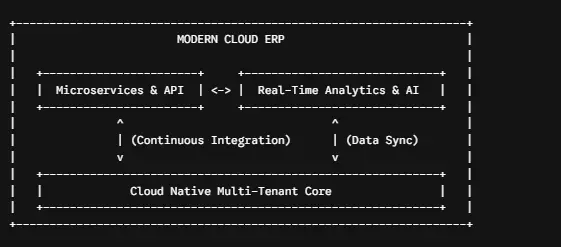
Transitioning enterprise clients from legacy infrastructure to cloud-native platforms requires a modular approach. Modern ERP founders should design scalable microservices architectures rather than tightly coupled monoliths. A modular system allows clients to adopt individual components—such as inventory tracking or billing—at their own pace before migrating their entire operational core.
Prioritizing API-First Design
In today’s software ecosystem, no ERP platform operates as an island. Enterprise customers rely on specialized third-party tools for customer relationship management, payment processing, marketing automation, and business intelligence. Modern platforms must prioritize robust, well-documented REST and GraphQL APIs to allow seamless integrations across existing enterprise stacks.
3. Product Development Strategies for ERP Platforms
Designing product features for an enterprise application requires a balanced focus on power, stability, and user experience. Historically, traditional software sacrificed usability for functional depth, resulting in steep learning curves and low employee adoption rates. Modern founders must challenge this paradigm.
- Consumer-Grade User Experience: Enterprise users expect software to feel as intuitive as consumer mobile applications. Simplifying complex data entry tasks, offering smart dashboards, and eliminating unnecessary sub-menus can drastically improve user retention and lower customer onboarding costs.
- Role-Based Access and Governance: Enterprise security demands strict governance models. Software architectures must support granular role-based permission management, detailed audit logs, and compliance mechanisms tailored to global regulatory frameworks like GDPR or SOC 2.
- Artificial Intelligence Integration: AI is no longer a peripheral marketing novelty; it is a core operational requirement. Incorporating machine learning models for predictive maintenance, intelligent cash flow forecasting, and automated document ingestion offers actionable business intelligence that legacy tools simply cannot match.
4. Go-To-Market (GTM) Models for Enterprise Founders
Acquiring customer contracts in the B2B enterprise software domain demands a multi-tiered sales strategy. Unlike self-service SaaS applications where signups happen instantly, closing an enterprise contract involves multiple stakeholders, procurement teams, compliance checks, and security evaluations.
Building Strategic Implementation Partnerships
A founder cannot scale enterprise software deployment on their own. Establishing a network of system integrators, value-added resellers (VARs), and industry consultants extends market reach exponentially. These ecosystem partners frequently hold established customer relationships and possess the domain expertise needed to lead complex customer implementations.
Mitigating Risk with Product-Led Growth Principles
While full-enterprise sales traditionally rely on top-down, high-touch sales organizations, introducing product-led growth (PLG) mechanics can drastically shorten sales cycles. Offering sandbox environments, free trial modules, or localized workflow tools allows departmental champions inside client organizations to test software capability before committing to enterprise-wide platform upgrades.
5. Overcoming Deployment and Churn Risks
For an ERP startup, initial customer acquisition is only half the battle. High churn rates during platform implementation can jeopardize unit economics and destroy market reputation.
Accelerating Time-to-Value (TTV)
The primary reason enterprise platform deployments stall or fail is prolonged implementation timelines. When software takes eighteen months to configure, organizational priorities shift, champions leave, and budgets get reallocated. Founders must invest heavily in automated migration tools, pre-configured industry templates, and intuitive data mapping utilities to drive down TTV.
Fostering Customer Success and Continuous Training
Platform adoption depends directly on organizational change management. Establishing dedicated customer success teams early in company growth ensures client employees receive adequate training and ongoing guidance. Providing self-paced learning academies, interactive documentation, and responsive support channels converts operational staff into long-term product advocates.
6. Financial Metrics and Unit Economics Every Founder Must Master
Sailing an enterprise platform through growth stages requires precise financial discipline. Standard SaaS metrics apply, but operational lead times and high customer acquisition costs require careful adjustment.
- Annual Recurring Revenue (ARR) Growth: Track predictable software subscriptions independently from one-time setup or professional services fees to maintain valuation accuracy.
- Customer Acquisition Cost (CAC) Payback: Given high contract values, enterprise customer acquisition costs can be substantial. Successful founders keep CAC payback periods under 18 to 24 months.
- Net Retention Rate (NRR): Enterprise platforms thrive through expansion opportunities. A healthy business targets an NRR above 110%, driven by seat expansions, module upgrades, and ecosystem add-ons.
- Ratio of Professional Services to Recurring Revenue: Professional services are essential for custom enterprise deployment, but excessive reliance on custom development lowers overall margin efficiency. Platform development must aim to minimize manual implementation services over time.
7. Fundraising and Navigating Investor Expectations
Securing capital for an enterprise platform requires articulating a clear vision to venture capital firms. Investors evaluate startups through specific lenses depending on growth stages.
Seed to Series A: Proving Product-Market Fit
At early stages, venture capitalists focus heavily on platform architecture, customer retention numbers, and initial customer metrics. Demonstrating that enterprise users actively use core modules daily validates that the product addresses real operational pain points.
Series B and Beyond: Scaling Growth Operations
Once product-market fit is established, funding rounds center on scaling distribution, expanding geographic footprint, and building out partner networks. Investors look for predictable sales pipelines, declining implementation times, and strong dollar-based net expansion metrics.
The Road Ahead for Enterprise Founders
Building an enterprise platform is a challenging yet rewarding venture. As businesses worldwide continue digital transformation initiatives, demand for flexible, secure, and modern cloud platforms continues to surge.
By focusing on vertical market opportunities, prioritizing modern API-driven architectures, delivering consumer-grade user experiences, and establishing robust implementation partnerships, an ERP founder can successfully disrupt legacy software categories and build an enduring, high-value technology platform.